Boom angle: meaning and why it matters
Boom angle is the angle between the boom and the horizontal, measured upward from level. Raising the boom increases the angle and pulls the load in toward the crane. Lowering it reduces the angle and pushes the load out, which increases radius and, on a load chart, usually lowers capacity.
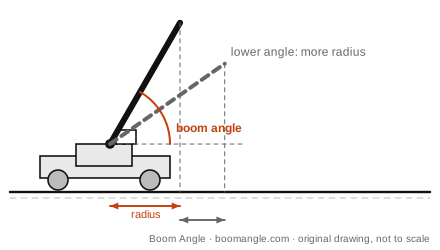
The angle sets the radius
With the boom length fixed, the angle decides how far out the tip is. Radius is boom length times the cosine of the angle, plus the small offset between the foot pin and the center of rotation. A 60 ft boom at 70 degrees puts the tip about 20.5 ft out, at 60 degrees about 30 ft, and at 50 degrees about 38.6 ft. Every few degrees you lower the boom adds several feet of radius.
Boom angle matters because a load chart is sorted by radius. When the boom comes down, you move right along the radius axis and, as a rule, to a smaller capacity.
Try one question
Question 1 of the free 10-question check on NCCCO written. No signup.
Operations
Which action creates side loading on a crane boom?
Choose an answer to begin
Where the angle shows up
- On an indicator. Cranes carry a boom angle indicator. OSHA's operational aids rule at 29 CFR 1926.1416 covers operational aids, which include boom angle and radius indicators, and the indicator is how you usually learn the angle on the job.
- In chart notes. Some charts print a minimum boom angle for a given boom length, or a range of angles that applies. Our practice chart PC-1 notes a minimum boom angle of 30 degrees for the 80 ft boom.
- In the problem. Some problems give you the angle and the boom length and expect you to find the radius first.
Ask Hook before you buy AI your Boom Angle study buddy
See what's on the NCCCO written exam, take the free 10-question check, or find the plan that fits you.
The NCCCO written course
Available now · instant accessLearn every outline domain, work load charts step by step, then prove it on timed exams.
- 8modules of lessonsEvery task on the outline
- 3timed practice exams95 questions in 90 minutes and 28 in 60
- 437practice questionsEach one explained
- 2worked calculationsStep by step
- 1week-by-week study planSet to your exam date
Turn a practice answer into a study step. In untimed practice, ask Hook AI about any question you answer, follow up, then see your weakest topics and what to drill next.
Instant access. Terms and refunds · Secure checkout by Stripe
Every answer comes with a full explanation.
Common mix-ups
- Angle from vertical. Boom angle is measured from horizontal. A boom straight up is 90 degrees, not 0.
- Thinking a steeper boom always means more capacity. Within a chart, a smaller radius generally gives a larger capacity, but the chart is the authority and the structural and stability limits can change which side you are on. See structural vs stability limits.
- Ignoring the minimum angle. A chart may say the boom must not be lowered below a stated angle for that length.
- Treating the angle as a substitute for radius. The angle gets you to the radius. The chart is read by radius.
On the NCCCO written exam
Boom angle limits are named in Load Charts task 4.4 of the 01/25 outline, alongside the rated capacity chart, range diagram, work area chart and parts of line. Load Charts is about 27% of Core. Expect to move between angle, length and radius in either direction, and to explain what happens to capacity as the boom is lowered.
Practice it
The crane radius and boom angle calculator works all three directions. Crane radius vs boom length covers the lookup side, and load moment explains why more radius is harder on the crane. See the whole set in the crane terms glossary.
Know the terms? Take the free 10-question check
Take the free 10-question check. It is scored by the Core outline domains and needs no signup, so you see whether site, operations, technical knowledge or load charts costs you the most points. Boom Angle's course then gives you a question bank with each answer key checked by a second solve, timed practice exams, and a study plan built from your exam date.
Sources
Show the list
- 29 CFR 1926.1416: Operational aids, OSHA.
- 29 CFR 1926.1417: Operation, OSHA.
- Mobile Crane Operator Candidate Handbook, CCO, Core outline tasks and weights (01/25 revision). Task numbers on this page follow it.
Facts checked 25 October 2026 against the sources listed above. If something has changed, tell us and we will correct it within 2 business days.
Your next step
Ready to see where you stand on NCCCO written?
Free, untimed and scored by domain. No signup.
Start the free 10-question checkCore + Specialty course. Lessons, timed practice exams and a plan around your exam date. Get Core + Specialty course · $99 See the plans or read the free sample lesson.Terms and refunds