Choker vs basket hitch: meaning and why it matters
A choker hitch wraps the sling around the load and passes one end through the other, so it tightens as the load comes up. A basket hitch cradles the load from below with both ends on the hook. The two hitches give a sling different ratings.
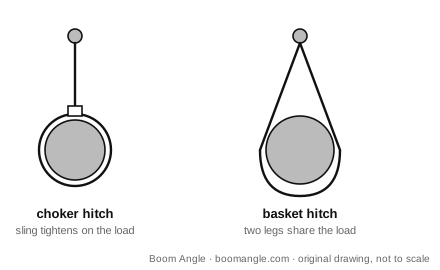
How each one carries load
Choker. The sling goes around the load and one end passes through the other end, or through a fitting, and the whole thing tightens as weight comes on. Only one leg is lifting, and the choke itself bends and pinches the sling. A choker's rating is lower than the same sling used straight, and it drops further as the angle at the choke gets tighter. The tag or the manufacturer's table gives the figure.
Basket. The sling passes under the load, with both ends going up to the hook or to a master link. Both legs carry, so with the legs vertical a basket hitch can be rated for up to about twice the straight rating, as long as the bend around the load is not too tight. As the legs spread, the angle factor takes capacity back. See sling angle factor.
Try one question
Question 1 of the free 10-question check on NCCCO written. No signup.
Operations
Which action creates side loading on a crane boom?
Choose an answer to begin
What each one is good for
| Choker | Basket | |
|---|---|---|
| Grip | Tightens on the load | Supports from below |
| Good for | Bundles, bars, pipe lifted by one sling | Loads with a place to cradle, or lifted with a pair |
| Watch for | Rating penalty, bending of the sling, a load that shifts | Load sliding out, tight bends, leg angle |
A basket on a smooth round load can slip out. Many users wrap the load or use a second wrap to hold it. A choker on a bundle can let pieces slide if the choke does not grip them all.
Ask Hook before you buy AI your Boom Angle study buddy
See what's on the NCCCO written exam, take the free 10-question check, or find the plan that fits you.
The NCCCO written course
Available now · instant accessLearn every outline domain, work load charts step by step, then prove it on timed exams.
- 8modules of lessonsEvery task on the outline
- 3timed practice exams95 questions in 90 minutes and 28 in 60
- 437practice questionsEach one explained
- 2worked calculationsStep by step
- 1week-by-week study planSet to your exam date
Turn a practice answer into a study step. In untimed practice, ask Hook AI about any question you answer, follow up, then see your weakest topics and what to drill next.
Instant access. Terms and refunds · Secure checkout by Stripe
Every answer comes with a full explanation.
An example
Suppose a sling is tagged at 5,000 lb for a straight vertical pull. In a basket with both legs vertical, the tag may allow close to 10,000 lb, but the same sling in a choker is rated below 5,000 lb, by an amount that depends on the choke angle. The numbers come from the tag. Never carry them over from another sling or another hitch.
Common mix-ups
- Treating the vertical rating as the choker rating. The choker rating is lower.
- Assuming a basket always doubles capacity. It does so only with vertical legs and a bend that is not too sharp.
- Choosing a hitch by habit. The load's shape and where it can be gripped decide.
- Forgetting the angle. A basket with spread legs is subject to the angle factor.
On the NCCCO written exam
Hitch types are rigging knowledge from Core task 3.5 (rigging devices) in Technical Knowledge, about 23% of the exam under the 01/25 handbook. The usual problem gives a sling's straight rating and asks which hitch lowers or raises it.
Practice it
Use the sling capacity calculator for choker, basket and bridle arrangements. Read sling angle factor and rated capacity vs working load limit next. The crane terms glossary lists the set.
Know the terms? Take the free 10-question check
Take the free 10-question check. It is scored by the Core outline domains and needs no signup, so you see whether site, operations, technical knowledge or load charts costs you the most points. Boom Angle's course then gives you a question bank with each answer key checked by a second solve, timed practice exams, and a study plan built from your exam date.
Sources
Show the list
- 29 CFR 1926.251: Rigging equipment for material handling, OSHA.
- Guidance on Safe Sling Use: Alloy Steel Chain Slings, OSHA.
- Hoisting and Rigging Fundamentals, TR244C Rev. 5, U.S. Department of Energy, sling loading.
- Mobile Crane Operator Candidate Handbook, CCO, Core outline tasks and weights (01/25 revision). Task numbers on this page follow it.
Facts checked 25 October 2026 against the sources listed above. If something has changed, tell us and we will correct it within 2 business days.
Your next step
Ready to see where you stand on NCCCO written?
Free, untimed and scored by domain. No signup.
Start the free 10-question checkCore + Specialty course. Lessons, timed practice exams and a plan around your exam date. Get Core + Specialty course · $99 See the plans or read the free sample lesson.Terms and refunds