Sling angle factor: meaning and why it matters
The sling angle factor is the number you multiply a leg's share of the load by to get the tension in that leg. It is one divided by the sine of the leg's angle from horizontal. Steep legs have a factor near one. Flat legs have a large one.
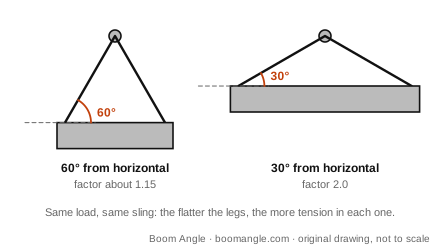
What the factor is
When a sling's legs are vertical, each leg carries its share of the load and nothing more. When the legs spread out, each one pulls partly sideways, and that sideways part adds tension without lifting anything. The flatter the leg, the more of its pull is wasted sideways, and the more tension it must carry to hold the same weight up.
Measured from the horizontal, the angle factor is one divided by the sine of the angle. Some tags and references measure from the vertical instead, in which case the factor is one divided by the cosine. Check which reference you have before you read a number.
| Angle from horizontal | Angle factor | Tension in a leg compared to its share |
|---|---|---|
| 90 degrees | 1.000 | no extra |
| 75 degrees | 1.035 | about 3.5% more |
| 60 degrees | 1.155 | about 15% more |
| 45 degrees | 1.414 | about 41% more |
| 30 degrees | 2.000 | double |
Try one question
Question 1 of the free 10-question check on NCCCO written. No signup.
Operations
Which action creates side loading on a crane boom?
Choose an answer to begin
A worked example
A 10,000 lb load hangs on a two-leg sling with equal legs and the hook above the center of gravity. Each leg's share is 5,000 lb.
- At 60 degrees, each leg carries 5,000 × 1.155 = about 5,775 lb.
- At 30 degrees, each leg carries 5,000 × 2.000 = 10,000 lb.
The load did not change. The sling's job doubled because the legs were laid flat. A sling rated for 6,000 lb per leg at its hitch is fine at 60 degrees in this example and overloaded at 30.
Ask Hook before you buy AI your Boom Angle study buddy
See what's on the NCCCO written exam, take the free 10-question check, or find the plan that fits you.
The NCCCO written course
Available now · instant accessLearn every outline domain, work load charts step by step, then prove it on timed exams.
- 8modules of lessonsEvery task on the outline
- 3timed practice exams95 questions in 90 minutes and 28 in 60
- 437practice questionsEach one explained
- 2worked calculationsStep by step
- 1week-by-week study planSet to your exam date
Turn a practice answer into a study step. In untimed practice, ask Hook AI about any question you answer, follow up, then see your weakest topics and what to drill next.
Instant access. Terms and refunds · Secure checkout by Stripe
Every answer comes with a full explanation.
Why shops set a floor
The factor climbs fast below 45 degrees. Guidance such as OSHA's note on chain slings advises against very flat angles unless the manufacturer or a qualified person recommends them. Our sling angle calculator flags angles below 45 degrees as a caution and below 30 degrees as critical. A longer sling or a spreader beam is the usual fix.
Common mix-ups
- Using the angle from the wrong reference. Horizontal and vertical give different factors for the same picture.
- Dividing the load by the number of legs and stopping. That gives the share, not the tension.
- Assuming each of three or four legs carries an equal part. Many references rate a multi-leg sling as though only two legs carry the load, since stiffer legs can take more.
- Forgetting the hitch. A leg's rating also depends on how it is hitched. See choker vs basket hitch.
On the NCCCO written exam
Rigging shows up in Technical Knowledge, about 23% of Core under the 01/25 handbook, where task 3.5 names rigging devices. Be ready to say that tension rises as the angle falls, and to work a leg's tension from a share and an angle.
Practice it
Enter your own legs in the sling angle calculator. Then read choker vs basket hitch and center of gravity of a load. The crane terms glossary covers the rest of the set.
Know the terms? Take the free 10-question check
Take the free 10-question check. It is scored by the Core outline domains and needs no signup, so you see whether site, operations, technical knowledge or load charts costs you the most points. Boom Angle's course then gives you a question bank with each answer key checked by a second solve, timed practice exams, and a study plan built from your exam date.
Sources
Show the list
- 29 CFR 1926.251: Rigging equipment for material handling, OSHA.
- Guidance on Safe Sling Use: Alloy Steel Chain Slings, OSHA.
- Hoisting and Rigging Fundamentals, TR244C Rev. 5, U.S. Department of Energy, sling loading.
- Mobile Crane Operator Candidate Handbook, CCO, Core outline tasks and weights (01/25 revision). Task numbers on this page follow it.
Facts checked 25 October 2026 against the sources listed above. If something has changed, tell us and we will correct it within 2 business days.
Your next step
Ready to see where you stand on NCCCO written?
Free, untimed and scored by domain. No signup.
Start the free 10-question checkCore + Specialty course. Lessons, timed practice exams and a plan around your exam date. Get Core + Specialty course · $99 See the plans or read the free sample lesson.Terms and refunds