Structural vs stability limits: meaning and why it matters
A structural limit is a capacity set by the strength of the crane's parts, such as the boom, rope or structure. A stability limit is a capacity set by the load that would tip the crane, with a margin. Every printed rating is governed by one of the two.
Two different reasons for the same number
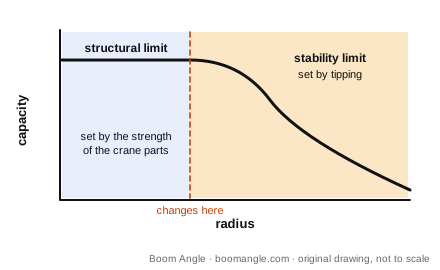
Each capacity on a chart is the smaller of two things. One is how much load the crane's parts can carry without being overstressed. The other is how much load the crane can hold before it would tip, less a margin. Close in, the crane is hard to tip and the parts are the limit. Farther out, the long arm of the load makes tipping the limit well before the parts are stressed.
That is why the printed capacity is nearly flat at short radius and then drops steadily. The flat part is structural. The sloping part is stability.
Try one question
Question 1 of the free 10-question check on NCCCO written. No signup.
Operations
Which action creates side loading on a crane boom?
Choose an answer to begin
Reading the difference
Many charts mark the boundary with a bold line, a shaded region or a legend note. Real charts differ, so read the chart's own legend rather than guessing from where a line falls. On our invented Practice A with an 80 ft boom, the 10 ft radius cell reads 28,000 lb, structural, and the 30 ft radius cell reads 24,000 lb, stability. The practice tool labels the basis so you can learn to see it.
OSHA 29 CFR 1926.1433 covers design, construction and testing of cranes. For what a particular cell is limited by, rely on the chart's legend and the manufacturer's instructions.
Ask Hook before you buy AI your Boom Angle study buddy
See what's on the NCCCO written exam, take the free 10-question check, or find the plan that fits you.
The NCCCO written course
Available now · instant accessLearn every outline domain, work load charts step by step, then prove it on timed exams.
- 8modules of lessonsEvery task on the outline
- 3timed practice exams95 questions in 90 minutes and 28 in 60
- 437practice questionsEach one explained
- 2worked calculationsStep by step
- 1week-by-week study planSet to your exam date
Turn a practice answer into a study step. In untimed practice, ask Hook AI about any question you answer, follow up, then see your weakest topics and what to drill next.
Instant access. Terms and refunds · Secure checkout by Stripe
Every answer comes with a full explanation.
Why it matters
- Remedies differ. More outrigger extension or counterweight can help a stability-limited cell, because those add resistance to tipping. They do nothing for a structural cell, where the parts are the limit.
- Warning signs differ. A crane near its stability limit gives signs, such as the outrigger on the far side unloading. A structural overload may give no sign before a part fails.
- Margins differ. The stability limit already includes a margin below the tipping load. The structural limit has margin of its own, but exceeding it risks damaging the crane.
Common mix-ups
- Thinking the bold line is the safe side. Both sides are limits. Neither side invites you to exceed the value.
- Believing the cell above the line is "stronger". It is a different limit, not a different amount of safety.
- Assuming extra counterweight raises every capacity. It helps stability cells only.
- Skipping the legend. The legend tells you what the line means on that chart.
On the NCCCO written exam
Core tasks 3.2 and 3.3 (terminology, functions and limitations) are where you explain why capacity falls with radius, and Load Charts task 4.4 is where you read the chart. Load Charts is about 27% of Core under the 01/25 handbook. Know which kind of overload may give a warning and which may not.
Practice it
The load chart practice tool labels each cell's basis on invented charts. Read tipping axis for the stability side and gross vs net capacity for what comes off the number afterward. The crane terms glossary lists the rest.
Know the terms? Take the free 10-question check
Take the free 10-question check. It is scored by the Core outline domains and needs no signup, so you see whether site, operations, technical knowledge or load charts costs you the most points. Boom Angle's course then gives you a question bank with each answer key checked by a second solve, timed practice exams, and a study plan built from your exam date.
Sources
Show the list
- 29 CFR 1926.1433: Design, construction and testing, OSHA.
- Mobile Crane Operator Candidate Handbook, CCO, Core outline tasks and weights (01/25 revision). Task numbers on this page follow it.
Facts checked 25 October 2026 against the sources listed above. If something has changed, tell us and we will correct it within 2 business days.
Your next step
Ready to see where you stand on NCCCO written?
Free, untimed and scored by domain. No signup.
Start the free 10-question checkCore + Specialty course. Lessons, timed practice exams and a plan around your exam date. Get Core + Specialty course · $99 See the plans or read the free sample lesson.Terms and refunds