Two-blocking: meaning and why it matters
Two-blocking happens when the hook block is pulled up against the boom tip sheaves, or whatever the load line runs over at the tip, with nowhere left to go. Further pull overloads the rope and the parts at the tip. It can part the rope and drop the load.
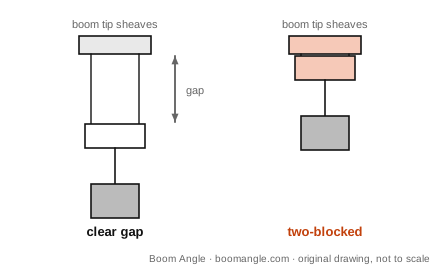
How it happens
Two-blocking is about the distance between the block and the boom tip. Anything that shrinks that distance without paying out line can close it:
- Hoisting up with the block already close to the tip.
- Extending a telescopic boom without paying out hoist line. The tip moves away from the crane and pulls the block up toward it, even if the hoist drum is not turning.
- Combining motions. Operators who telescope and swing or hoist together can lose track of the gap.
- A distracted look away. The block is high above you and easy to misjudge, especially with a long boom.
Try one question
Question 1 of the free 10-question check on NCCCO written. No signup.
Operations
Which action creates side loading on a crane boom?
Choose an answer to begin
Why it is dangerous
When the block meets the tip, the hoist can keep pulling. The rope, the block's sheaves and the tip structure take loads they were not sized for. The rope can part, and a parted rope drops the load and the block. Even without a break, two-blocking can damage the rope and the tip so that the damage shows up later.
Ask Hook before you buy AI your Boom Angle study buddy
See what's on the NCCCO written exam, take the free 10-question check, or find the plan that fits you.
The NCCCO written course
Available now · instant accessLearn every outline domain, work load charts step by step, then prove it on timed exams.
- 8modules of lessonsEvery task on the outline
- 3timed practice exams95 questions in 90 minutes and 28 in 60
- 437practice questionsEach one explained
- 2worked calculationsStep by step
- 1week-by-week study planSet to your exam date
Turn a practice answer into a study step. In untimed practice, ask Hook AI about any question you answer, follow up, then see your weakest topics and what to drill next.
Instant access. Terms and refunds · Secure checkout by Stripe
Every answer comes with a full explanation.
What guards against it
Operational aids cover part of the risk. OSHA 29 CFR 1926.1416 addresses operational aids, which include devices for two-blocking. Read the section for when each one is required. They do not replace the operator's own watch. A device can fail, be bypassed, or not fit a particular setup, and a signal person's view and the operator's habits are the main protection.
A few habits make the gap visible:
- Keep the load line's travel in view and leave a margin at the top.
- When extending the boom, pay out hoist line at the same time.
- Know how much line is out before moving the boom.
Common mix-ups
- Two-blocking is not overload. The load can be light and the block can still hit the tip.
- Two-blocking is not a swinging problem. It is about vertical distance.
- "The hoist is stopped so it is safe." A moving boom can close the gap without the hoist moving.
- Relying only on the device. It helps, but it is a backup.
On the NCCCO written exam
Under the 01/25 outline, Operations tasks 2.12 and 2.13 cover operator aids and what to do when they fail, and task 3.7 covers hook blocks and overhaul balls. Operations is about 28% of Core and Technical Knowledge about 23%. Expect to see what causes two-blocking, which motion to avoid and what a device does. A common trap answer is hoisting up to clear an obstacle without checking the gap.
Practice it
The line itself is the reeving: see the crane parts of line calculator for how parts of line set hook load and line pull. Read rated capacity indicator vs limiter for devices that warn, and shock loading for what sudden stops do to the line. The crane terms glossary lists the full set.
Know the terms? Take the free 10-question check
Take the free 10-question check. It is scored by the Core outline domains and needs no signup, so you see whether site, operations, technical knowledge or load charts costs you the most points. Boom Angle's course then gives you a question bank with each answer key checked by a second solve, timed practice exams, and a study plan built from your exam date.
Sources
Show the list
- 29 CFR 1926.1416: Operational aids, OSHA.
- 29 CFR 1926.1417: Operation, OSHA.
- Mobile Crane Operator Candidate Handbook, CCO, Core outline tasks and weights (01/25 revision). Task numbers on this page follow it.
Facts checked 25 October 2026 against the sources listed above. If something has changed, tell us and we will correct it within 2 business days.
Your next step
Ready to see where you stand on NCCCO written?
Free, untimed and scored by domain. No signup.
Start the free 10-question checkCore + Specialty course. Lessons, timed practice exams and a plan around your exam date. Get Core + Specialty course · $99 See the plans or read the free sample lesson.Terms and refunds