Outrigger setup: meaning and why it matters
An outrigger setup is how a crane's support is arranged for a lift: how far each beam is extended, how the jacks are set, and what the floats sit on. A load chart's ratings only apply to the setup it names, so the setup must match the chart before any capacity is read.
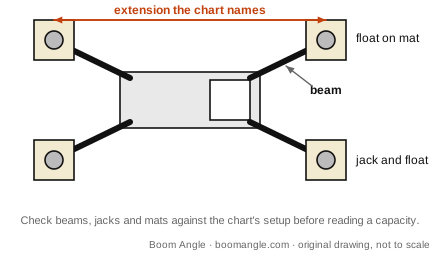
The parts
- Beams. The horizontal members that slide out from the carrier. A chart usually names the beam position it was rated for, such as fully extended, or an intermediate position where the crane has one.
- Jacks. The vertical cylinders at the end of each beam. They take the crane's weight onto the floats and level the carrier.
- Floats. The pads at the foot of each jack.
- Mats or cribbing. Material under the floats that spreads the load into the ground. See outrigger mats and ground pressure.
Try one question
Question 1 of the free 10-question check on NCCCO written. No signup.
Operations
Which action creates side loading on a crane boom?
Choose an answer to begin
Why the chart cares
The wider the outriggers, the farther the tipping axis sits from the crane's center, and the more the crane can lift at a given radius. So the manufacturer prints ratings per beam position. On our invented chart PC-1, a 60 ft boom at a 20 ft radius is rated 31,000 lb gross with fully extended outriggers. The mid-extension table for the same boom and radius reads 23,000 lb. At 25 ft the pair is 24,500 lb and 18,000 lb. Same crane, same boom, same radius, but a different setup and a different capacity.
If the beams are not out as far as the chart's table assumes, that table does not apply. Read the table for the setup you actually have, and check the chart's notes for whether beams may be set to different extensions on different sides.
Ask Hook before you buy AI your Boom Angle study buddy
See what's on the NCCCO written exam, take the free 10-question check, or find the plan that fits you.
The NCCCO written course
Available now · instant accessLearn every outline domain, work load charts step by step, then prove it on timed exams.
- 8modules of lessonsEvery task on the outline
- 3timed practice exams95 questions in 90 minutes and 28 in 60
- 437practice questionsEach one explained
- 2worked calculationsStep by step
- 1week-by-week study planSet to your exam date
Turn a practice answer into a study step. In untimed practice, ask Hook AI about any question you answer, follow up, then see your weakest topics and what to drill next.
Instant access. Terms and refunds · Secure checkout by Stripe
Every answer comes with a full explanation.
A setup check, in order
- Which setup does the chart table name?
- Are all beams at the extension that table needs?
- Are the jacks extended and the crane level to the manufacturer's limit?
- What is under each float, and is it large and firm enough? OSHA 29 CFR 1926.1402 covers ground conditions for crane work.
Common mix-ups
- Reading the fully extended table on partly extended beams. It is the most expensive mistake on the written exam, because the capacity it gives is too high.
- Mixing the setup with the working area. They are separate settings that the chart pairs. See quadrant of operation.
- Assuming the floats can sit on bare ground. The chart does not rate the ground, so you check it.
- Skipping the level check. Rated capacities assume the crane is level within the manufacturer's limit.
On the NCCCO written exam
Setup shows up in three places under the 01/25 outline. Site tasks 1.1 and 1.2 cover ground stability, mats and cribbing (Site is about 22% of Core). Operations tasks 2.1 to 2.4 cover leveling. Load Charts, about 27%, is where you choose the table. A problem that says the beams are partly extended is testing whether you reach for the right table.
Practice it
The outrigger pad calculator sizes mats from a float load and a ground bearing value. Then read outrigger mats and ground pressure and quadrant of operation. The crane terms glossary has the rest of the set.
Know the terms? Take the free 10-question check
Take the free 10-question check. It is scored by the Core outline domains and needs no signup, so you see whether site, operations, technical knowledge or load charts costs you the most points. Boom Angle's course then gives you a question bank with each answer key checked by a second solve, timed practice exams, and a study plan built from your exam date.
Sources
Show the list
- 29 CFR 1926.1402: Ground conditions, OSHA.
- 29 CFR 1926.1404: Assembly/Disassembly, general requirements, OSHA.
- Mobile Crane Operator Candidate Handbook, CCO, Core outline tasks and weights (01/25 revision). Task numbers on this page follow it.
Facts checked 25 October 2026 against the sources listed above. If something has changed, tell us and we will correct it within 2 business days.
Your next step
Ready to see where you stand on NCCCO written?
Free, untimed and scored by domain. No signup.
Start the free 10-question checkCore + Specialty course. Lessons, timed practice exams and a plan around your exam date. Get Core + Specialty course · $99 See the plans or read the free sample lesson.Terms and refunds