Crane capacity deductions: meaning and why it matters
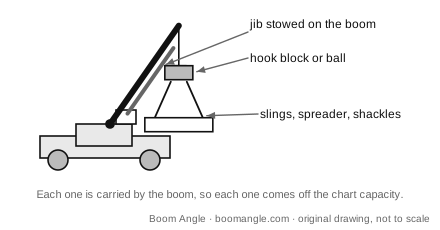
A capacity deduction is the weight of anything the boom carries besides the load, subtracted from the chart's gross capacity. Typical deductions are the hook block or ball, slings and spreader bars, and a jib or other attachment the chart notes name. Add them all, then subtract once.
What counts as a deduction
The test is simple: if the boom is holding it up, it is part of the lift. The common cases are:
- The hook block or headache ball. The chart notes usually give a weight for each. On our practice chart PC-1 the note gives 750 lb for the hook block.
- All rigging. Slings, shackles, spreader or lifting beams and any other gear between the hook and the load. This is the one the operator has to find out, because it depends on the job.
- Attachments. A jib that is erected, or stowed on the boom, usually has its own deduction in the chart notes. Our practice chart LC-2 lists a jib-erected deduction of 3,200 lb. The attachment's deduction depends on its state, so read which one the note means.
- Anything else the notes list. Some charts name auxiliary hoist items or other devices. The note governs.
The load's own weight is not a deduction. It is the thing you are comparing against what is left.
Try one question
Question 1 of the free 10-question check on NCCCO written. No signup.
Operations
Which action creates side loading on a crane boom?
Choose an answer to begin
Add first, subtract once
Work in two steps. First total every deduction. Then subtract that one total from the gross figure. Subtracting item by item invites a slip in the middle of a three-step chain, and with no calculator on the Core exam, fewer steps means fewer errors.
On PC-1 at a 60 ft boom and a 30 ft radius, gross is 19,500 lb. With the 750 lb hook block and 400 lb of rigging, deductions are 1,150 lb and net is 18,350 lb.
Ask Hook before you buy AI your Boom Angle study buddy
See what's on the NCCCO written exam, take the free 10-question check, or find the plan that fits you.
The NCCCO written course
Available now · instant accessLearn every outline domain, work load charts step by step, then prove it on timed exams.
- 8modules of lessonsEvery task on the outline
- 3timed practice exams95 questions in 90 minutes and 28 in 60
- 437practice questionsEach one explained
- 2worked calculationsStep by step
- 1week-by-week study planSet to your exam date
Turn a practice answer into a study step. In untimed practice, ask Hook AI about any question you answer, follow up, then see your weakest topics and what to drill next.
Instant access. Terms and refunds · Secure checkout by Stripe
Every answer comes with a full explanation.
Common mix-ups
- Forgetting the block. Operators see the load and the slings and treat the block as part of the crane. The chart treats it as weight on the boom.
- Deducting a stowed jib that the chart does not ask for, or skipping one it does. The note tells you which condition triggers a deduction.
- Deducting the load. Net capacity is not gross minus the load. It is gross minus the gear.
- Mixing units. Keep pounds beside every number. A boom length or a radius in feet has no place in the sum.
On the NCCCO written exam
A load chart problem usually hands you the gross number and a list of weights, and asks for net or for whether a load fits. The wrong answers are built from the two or three most likely slips, such as leaving out one deduction or deducting the load. Under the 01/25 handbook, Load Charts is about 27% of Core, so this skill pays across many problems.
Practice it
Run the numbers on the net capacity worksheet. For the step before this one, read gross vs net capacity. A related idea sits on the rigging side: rated capacity vs working load limit separates the crane's limit from the limit on each piece of gear. Every term in this set is in the crane terms glossary.
Know the terms? Take the free 10-question check
Take the free 10-question check. It is scored by the Core outline domains and needs no signup, so you see whether site, operations, technical knowledge or load charts costs you the most points. Boom Angle's course then gives you a question bank with each answer key checked by a second solve, timed practice exams, and a study plan built from your exam date.
Sources
Show the list
- 29 CFR 1926.1417: Operation, OSHA.
- Mobile Crane Operator Candidate Handbook, CCO, Core outline tasks and weights (01/25 revision). Task numbers on this page follow it.
Facts checked 25 October 2026 against the sources listed above. If something has changed, tell us and we will correct it within 2 business days.
Your next step
Ready to see where you stand on NCCCO written?
Free, untimed and scored by domain. No signup.
Start the free 10-question checkCore + Specialty course. Lessons, timed practice exams and a plan around your exam date. Get Core + Specialty course · $99 See the plans or read the free sample lesson.Terms and refunds