Side loading: meaning and why it matters
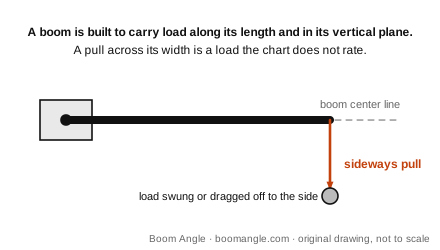
Side loading is a force that acts across the boom, from side to side, instead of along its length and in its vertical plane. It comes from dragging a load sideways, swinging too fast, wind on the load or a load line that is not plumb. A boom is weak against it.
Why the boom does not like it
A boom is built like a long column. It is strong when the load pushes it along its length and bends it up and down in its own vertical plane, because that is what lifting does. A force across its width bends it the way it was not designed to bend. The longer the boom, the worse it gets, since a long boom has a long arm for the side force to work on. A telescopic boom's extended sections add to the problem.
Load charts rate a freely suspended load hanging straight from the tip. Nothing in the printed capacity covers a sideways pull.
Try one question
Question 1 of the free 10-question check on NCCCO written. No signup.
Operations
Which action creates side loading on a crane boom?
Choose an answer to begin
What causes it
- Dragging or pulling a load sideways to line it up or free it from the ground.
- Swinging too fast or stopping a swing hard. The load's inertia pulls the tip sideways. See shock loading.
- A load line that is not plumb when the load leaves the ground, so the load swings to the side as it rises.
- Wind on a large load. A big surface area turns wind into side force.
- Working over uneven or sloped support. A crane that is not level can put a sideways component on the boom.
Ask Hook before you buy AI your Boom Angle study buddy
See what's on the NCCCO written exam, take the free 10-question check, or find the plan that fits you.
The NCCCO written course
Available now · instant accessLearn every outline domain, work load charts step by step, then prove it on timed exams.
- 8modules of lessonsEvery task on the outline
- 3timed practice exams95 questions in 90 minutes and 28 in 60
- 437practice questionsEach one explained
- 2worked calculationsStep by step
- 1week-by-week study planSet to your exam date
Turn a practice answer into a study step. In untimed practice, ask Hook AI about any question you answer, follow up, then see your weakest topics and what to drill next.
Instant access. Terms and refunds · Secure checkout by Stripe
Every answer comes with a full explanation.
What to do instead
- Center the boom tip over the load before it leaves the ground.
- Lift straight up and let the load settle before swinging.
- Swing smoothly and use tag lines to control the load's rotation rather than pulling it with the boom.
- Treat a stuck load as a stop-and-think situation. Pulling free with the boom is a side or overload risk.
- Check the chart notes and the manufacturer's instructions for any further conditions.
OSHA 29 CFR 1926.1417 covers operation, including following the manufacturer's procedures and limits.
Common mix-ups
- Side loading is not the same as the working area. The working area names the part of the circle where certain ratings apply. Side loading is a force direction, which can happen in any area.
- A plumb line is not a weight limit. A load under capacity can still damage a boom if it is dragged sideways.
- Counting on the chart's margin. The margin covers a hanging load, not a sideways pull.
On the NCCCO written exam
Core tasks 2.16 to 2.19 cover dynamic and side loading, deflection and weather, and Operations is about 28% of Core under the 01/25 handbook. Problems often describe a lift, such as pulling a load toward the crane across the ground, and ask what is wrong. The answer is to hoist vertically first.
Practice it
How to read a crane load chart explains what the printed ratings cover and what they do not. Tail swing covers the area behind the crane, and shock loading covers sudden forces. The crane terms glossary lists the set.
Know the terms? Take the free 10-question check
Take the free 10-question check. It is scored by the Core outline domains and needs no signup, so you see whether site, operations, technical knowledge or load charts costs you the most points. Boom Angle's course then gives you a question bank with each answer key checked by a second solve, timed practice exams, and a study plan built from your exam date.
Sources
Show the list
- 29 CFR 1926.1417: Operation, OSHA.
- Mobile Crane Operator Candidate Handbook, CCO, Core outline tasks and weights (01/25 revision). Task numbers on this page follow it.
Facts checked 25 October 2026 against the sources listed above. If something has changed, tell us and we will correct it within 2 business days.
Your next step
Ready to see where you stand on NCCCO written?
Free, untimed and scored by domain. No signup.
Start the free 10-question checkCore + Specialty course. Lessons, timed practice exams and a plan around your exam date. Get Core + Specialty course · $99 See the plans or read the free sample lesson.Terms and refunds