Shock loading: meaning and why it matters
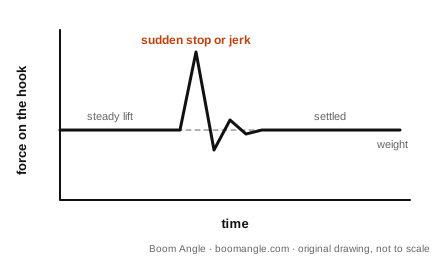
Shock loading is the extra force that a sudden start, stop or jerk puts on a crane, rope and rigging, beyond the weight of the load. A load that is snatched, dropped onto slack line or stopped hard briefly pulls much harder than it weighs, so chart limits can be exceeded with a load well under capacity.
Static and dynamic
A load hanging still pulls down with its weight. A load that is speeding up, slowing down or swinging pulls with its weight plus the force needed to change its motion. The faster the change, the larger the extra. A jerk is a very fast change.
Charts rate a load handled smoothly. They do not tell you how much extra force a snatch adds, because it depends on the speed, the stiffness of the line and how suddenly the motion stops. All you need to know is that it can be much higher than the weight, and that the printed capacity assumes you do not create it.
Try one question
Question 1 of the free 10-question check on NCCCO written. No signup.
Operations
Which action creates side loading on a crane boom?
Choose an answer to begin
Common causes
- Taking up slack fast. A slack sling or line snaps taut under power.
- Starting or stopping a hoist or swing suddenly.
- Stopping a swing with the controls instead of letting it ease out.
- A load breaking free from the ground, mud, ice or another object, so that it springs up.
- A load dropped a short distance and caught. A free fall that ends abruptly is a shock.
- Wind gusts on a large load.
Ask Hook before you buy AI your Boom Angle study buddy
See what's on the NCCCO written exam, take the free 10-question check, or find the plan that fits you.
The NCCCO written course
Available now · instant accessLearn every outline domain, work load charts step by step, then prove it on timed exams.
- 8modules of lessonsEvery task on the outline
- 3timed practice exams95 questions in 90 minutes and 28 in 60
- 437practice questionsEach one explained
- 2worked calculationsStep by step
- 1week-by-week study planSet to your exam date
Turn a practice answer into a study step. In untimed practice, ask Hook AI about any question you answer, follow up, then see your weakest topics and what to drill next.
Instant access. Terms and refunds · Secure checkout by Stripe
Every answer comes with a full explanation.
Habits that prevent it
- Take up slack slowly and stop when the load just comes off the ground.
- Use smooth control motions, with gentle starts and stops.
- Slow down near the end of a travel.
- Use the signals that call for slow motion. The standard "move slowly" signal asks for a slower motion alongside another command.
- Avoid pulling a stuck load free with the crane. See side loading.
OSHA 29 CFR 1926.1417 covers operation under the manufacturer's procedures and limits.
Common mix-ups
- A light load cannot be a problem. A snatch can make a light load pull hard on the rigging.
- Shock only hurts the crane. Slings, shackles and lifting lugs take it too.
- Shock is the same as two-blocking. They are separate hazards, though a sudden stop against the tip makes both. See two-blocking.
On the NCCCO written exam
Dynamic loading is named in Core tasks 2.16 to 2.19, with side loading, deflection and weather, in Operations, about 28% of the exam under the 01/25 handbook. Expect to pick the action that avoids a shock, such as easing the swing to a stop.
Practice it
Signals set the pace of a lift, and the crane hand signals drill trains you to name all the standard signals, including the ones that ask for slower motion or a stop. Read two-blocking and side loading next. The crane terms glossary lists the set.
Know the terms? Take the free 10-question check
Take the free 10-question check. It is scored by the Core outline domains and needs no signup, so you see whether site, operations, technical knowledge or load charts costs you the most points. Boom Angle's course then gives you a question bank with each answer key checked by a second solve, timed practice exams, and a study plan built from your exam date.
Sources
Show the list
- 29 CFR 1926.1417: Operation, OSHA.
- 29 CFR 1926.1433: Design, construction and testing, OSHA.
- Mobile Crane Operator Candidate Handbook, CCO, Core outline tasks and weights (01/25 revision). Task numbers on this page follow it.
Facts checked 25 October 2026 against the sources listed above. If something has changed, tell us and we will correct it within 2 business days.
Your next step
Ready to see where you stand on NCCCO written?
Free, untimed and scored by domain. No signup.
Start the free 10-question checkCore + Specialty course. Lessons, timed practice exams and a plan around your exam date. Get Core + Specialty course · $99 See the plans or read the free sample lesson.Terms and refunds