Outrigger mats and ground pressure: meaning and why it matters
Ground pressure is the force on the soil divided by the area carrying it. An outrigger float concentrates a large force on a small area. A mat or crib under the float spreads the same force over more ground, so the pressure falls to a level the soil can hold.
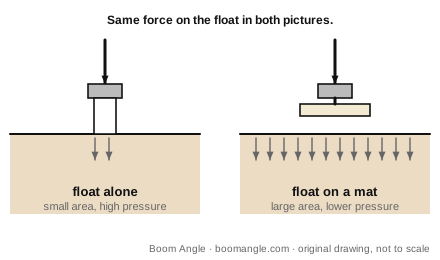
The arithmetic
Pressure equals force divided by area. If an outrigger float puts 40,000 lb on 4 square feet of soil, the pressure is 10,000 lb per square foot. Put a mat under it and the same 40,000 lb on 16 square feet is 2,500 lb per square foot. The force did not change. The area did.
Going the other way, the area a mat needs is the float load divided by the pressure the ground can take. If the soil can carry 2,000 lb per square foot, which is an invented figure for this example, then 40,000 lb needs at least 20 square feet, or about 4.5 ft by 4.5 ft. The outrigger pad calculator does this step and shows the working.
Try one question
Question 1 of the free 10-question check on NCCCO written. No signup.
Operations
Which action creates side loading on a crane boom?
Choose an answer to begin
Where the numbers come from
- The float load. It comes from the crane manufacturer's data for the setup and the load, not from the weight of the lift alone. The loaded-side float carries a large share of the crane's own weight as well as the load.
- The allowable ground pressure. It comes from someone who knows the soil. A guess is not a number.
- The mat's size and stiffness. A mat that bends under the float spreads the force less than a stiff one.
OSHA 29 CFR 1926.1402 covers ground conditions and who is responsible for them. Read the section itself for the requirements, and use the crane manufacturer's instructions for the support the crane needs.
Ask Hook before you buy AI your Boom Angle study buddy
See what's on the NCCCO written exam, take the free 10-question check, or find the plan that fits you.
The NCCCO written course
Available now · instant accessLearn every outline domain, work load charts step by step, then prove it on timed exams.
- 8modules of lessonsEvery task on the outline
- 3timed practice exams95 questions in 90 minutes and 28 in 60
- 437practice questionsEach one explained
- 2worked calculationsStep by step
- 1week-by-week study planSet to your exam date
Turn a practice answer into a study step. In untimed practice, ask Hook AI about any question you answer, follow up, then see your weakest topics and what to drill next.
Instant access. Terms and refunds · Secure checkout by Stripe
Every answer comes with a full explanation.
What to watch
- Mats centered under the float, not hanging off one side.
- Ground that looks dry but sits on fill, a trench, buried utilities or a slope.
- Rain, which can soften soil that carried the crane the day before.
- Settling during the lift. Level can change as the ground gives.
Common mix-ups
- Bigger mat always fixes it. It helps bearing pressure, but weak soil under a deep layer or a void can still fail.
- Mats make the crane more stable. They spread force to the ground. They do not change the chart.
- Using the crane's weight alone. The float load includes the lifted load and the boom's effect.
- Mixing units. Pounds and square feet, or kips and square inches, must match the allowable figure's units.
On the NCCCO written exam
Core tasks 1.1 and 1.2 cover ground stability, mats and cribbing, in Site, about 22% of the exam under the 01/25 handbook. Expect a short pressure problem done by hand, or a question about what to check before setting up on soft ground.
Practice it
Run your own float loads in the outrigger pad calculator. Read outrigger setup for the beams and jacks above the mat, and tipping axis for why the loaded float carries so much. The crane terms glossary lists the set.
Know the terms? Take the free 10-question check
Take the free 10-question check. It is scored by the Core outline domains and needs no signup, so you see whether site, operations, technical knowledge or load charts costs you the most points. Boom Angle's course then gives you a question bank with each answer key checked by a second solve, timed practice exams, and a study plan built from your exam date.
Sources
Show the list
- 29 CFR 1926.1402: Ground conditions, OSHA.
- 29 CFR 1926.1404: Assembly/Disassembly, general requirements, OSHA.
- Mobile Crane Operator Candidate Handbook, CCO, Core outline tasks and weights (01/25 revision). Task numbers on this page follow it.
Facts checked 25 October 2026 against the sources listed above. If something has changed, tell us and we will correct it within 2 business days.
Your next step
Ready to see where you stand on NCCCO written?
Free, untimed and scored by domain. No signup.
Start the free 10-question checkCore + Specialty course. Lessons, timed practice exams and a plan around your exam date. Get Core + Specialty course · $99 See the plans or read the free sample lesson.Terms and refunds