Tipping axis: meaning and why it matters
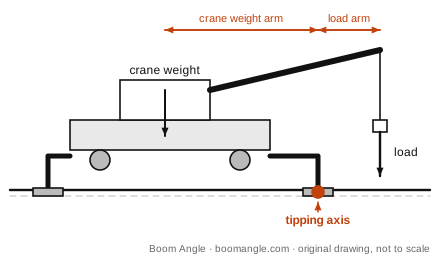
The tipping axis is the line on the ground that a crane would pivot about if it tipped over. On outriggers it runs between the floats on the loaded side. The load tries to turn the crane about that line, and the crane's own weight holds it back.
What it is
If a crane overloaded itself and began to tip, it would not fall at random. It would rotate about one line, the edge of its support on the side where the load is. That line is the tipping axis. The load hangs on one side of it and tries to turn the crane over. The crane's weight, the counterweight and everything else on the far side of the line push the other way. A lift is stable while the pushing back is larger than the turning.
Try one question
Question 1 of the free 10-question check on NCCCO written. No signup.
Operations
Which action creates side loading on a crane boom?
Choose an answer to begin
Where the line sits
- On outriggers: between the two floats on the side the load is working over. Swing the boom to a different area and a different pair of floats becomes the axis.
- On crawlers: along the edge of the track on the loaded side.
- On rubber tires: at the tire contact on the loaded side, which is one reason rubber-tire ratings are different from outrigger ratings.
This is why the working area changes the rating: a different area means a different axis, and the distance from the load line to it changes. The arm that counts for stability runs from the load line to the axis, while chart radius runs from the center of rotation. Charts account for the difference, so you read the radius the chart asks for.
Ask Hook before you buy AI your Boom Angle study buddy
See what's on the NCCCO written exam, take the free 10-question check, or find the plan that fits you.
The NCCCO written course
Available now · instant accessLearn every outline domain, work load charts step by step, then prove it on timed exams.
- 8modules of lessonsEvery task on the outline
- 3timed practice exams95 questions in 90 minutes and 28 in 60
- 437practice questionsEach one explained
- 2worked calculationsStep by step
- 1week-by-week study planSet to your exam date
Turn a practice answer into a study step. In untimed practice, ask Hook AI about any question you answer, follow up, then see your weakest topics and what to drill next.
Instant access. Terms and refunds · Secure checkout by Stripe
Every answer comes with a full explanation.
Why it matters for the chart
Where a cell is stability-limited, the printed capacity is set below the load that would tip the crane about this axis, with a margin built in. More radius means a longer arm for the load, so the turning effect grows, and capacity falls. See load moment for the arithmetic and structural vs stability limits for how to tell which kind of limit a cell reflects.
Common mix-ups
- Thinking the axis is the center of rotation. The center of rotation is the pin the superstructure turns on. The tipping axis is a line on the ground.
- Thinking the axis never moves. It moves with the working area and the support setup.
- Treating the margin as spare capacity. The chart already took it off. It is not extra.
- Expecting a warning every time. A crane near its stability limit may show light outriggers first. A structural overload may give no such sign.
On the NCCCO written exam
Core tasks 3.2 and 3.3 cover terminology, functions and limitations, which is where stability physics sits in Technical Knowledge (about 23% of Core under the 01/25 handbook). Be ready to say why capacity falls as radius grows, what changes when the boom swings to another area, and what a working area diagram tells you.
Practice it
Use the load chart practice tool to see how capacity falls with radius. Load moment puts numbers on the turning effect, and structural vs stability limits separates the two kinds of limit. The crane terms glossary lists the whole set.
Know the terms? Take the free 10-question check
Take the free 10-question check. It is scored by the Core outline domains and needs no signup, so you see whether site, operations, technical knowledge or load charts costs you the most points. Boom Angle's course then gives you a question bank with each answer key checked by a second solve, timed practice exams, and a study plan built from your exam date.
Sources
Show the list
- 29 CFR 1926.1433: Design, construction and testing, OSHA.
- Mobile Crane Operator Candidate Handbook, CCO, Core outline tasks and weights (01/25 revision). Task numbers on this page follow it.
Facts checked 25 October 2026 against the sources listed above. If something has changed, tell us and we will correct it within 2 business days.
Your next step
Ready to see where you stand on NCCCO written?
Free, untimed and scored by domain. No signup.
Start the free 10-question checkCore + Specialty course. Lessons, timed practice exams and a plan around your exam date. Get Core + Specialty course · $99 See the plans or read the free sample lesson.Terms and refunds