Gross vs net capacity: meaning and why it matters
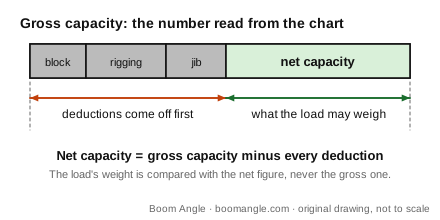
Gross capacity is the figure a load chart prints for one radius and boom length, before anything hanging from the boom is counted. Net capacity is what is left after every deduction comes off, which makes it the most the load itself may weigh. Compare the load to net, never to gross.
Why the chart prints gross
A chart is written for the crane, and the crane does not know what you will hang from it. The number in the cell assumes nothing about your hook block, your slings or a jib folded onto the boom. Those things are real weight on the boom, and the chart leaves it to you to take them off. That is why the first question on a lift is not "what does the cell say" but "what is left for the load after my gear."
Some manufacturers print charts that already include certain items, and the notes say so. Read the note before you assume. The practice charts on this site are gross, and their rule text says to deduct the hook block, all rigging and any attachment deduction the notes list.
Try one question
Question 1 of the free 10-question check on NCCCO written. No signup.
Operations
Which action creates side loading on a crane boom?
Choose an answer to begin
A worked example on a practice chart
Take our invented chart PC-1, a telescopic crane on fully extended outriggers over 360 degrees. At a 60 ft boom and a 30 ft radius the cell reads 19,500 lb. That is gross.
| Step | Work |
|---|---|
| Hook block (from the chart notes) | 750 lb |
| Rigging (set by the problem) | 400 lb |
| Total deductions | 750 + 400 = 1,150 lb |
| Net capacity | 19,500 - 1,150 = 18,350 lb |
An 18,000 lb load fits under 18,350 lb with 350 lb to spare. An 18,500 lb load does not, even though it sits below the 19,500 lb gross figure. That gap, a load that is under gross but over net, is exactly what the written exam builds problems around.
Ask Hook before you buy AI your Boom Angle study buddy
See what's on the NCCCO written exam, take the free 10-question check, or find the plan that fits you.
The NCCCO written course
Available now · instant accessLearn every outline domain, work load charts step by step, then prove it on timed exams.
- 8modules of lessonsEvery task on the outline
- 3timed practice exams95 questions in 90 minutes and 28 in 60
- 437practice questionsEach one explained
- 2worked calculationsStep by step
- 1week-by-week study planSet to your exam date
Turn a practice answer into a study step. In untimed practice, ask Hook AI about any question you answer, follow up, then see your weakest topics and what to drill next.
Instant access. Terms and refunds · Secure checkout by Stripe
Every answer comes with a full explanation.
Common mix-ups
- Comparing the load to gross. It is the single most common slip. The load is checked against net.
- Subtracting only the hook block. Rigging, spreader bars and any attachment the notes name come off too. Add the deductions first, then subtract once.
- Mixing the two in a percent. Work a percent of capacity with the load alone against net, or with the load plus every deduction against gross. Putting the load alone over gross understates how loaded the crane is.
- Calling a printed cell "net" without checking. Charts differ. The notes say which kind of number you are reading.
On the NCCCO written exam
Load Charts carries about 27% of the Core exam under the 01/25 handbook, and the Core exam allows no calculator. Gross-to-net is hand arithmetic: three small numbers to add and one subtraction. Practice doing it on paper and writing the unit beside every figure so a radius or a boom length never sneaks into the sum.
Practice it
The net capacity worksheet lays the subtraction out step by step. Crane capacity deductions covers what counts as a deduction, and structural vs stability limits covers why the gross number is limited in the first place. The crane terms glossary lists every term in this set.
Know the terms? Take the free 10-question check
Take the free 10-question check. It is scored by the Core outline domains and needs no signup, so you see whether site, operations, technical knowledge or load charts costs you the most points. Boom Angle's course then gives you a question bank with each answer key checked by a second solve, timed practice exams, and a study plan built from your exam date.
Sources
Show the list
- 29 CFR 1926.1417: Operation, OSHA.
- 29 CFR 1926.1433: Design, construction and testing, OSHA.
- Mobile Crane Operator Candidate Handbook, CCO, Core outline tasks and weights (01/25 revision). Task numbers on this page follow it.
Facts checked 25 October 2026 against the sources listed above. If something has changed, tell us and we will correct it within 2 business days.
Your next step
Ready to see where you stand on NCCCO written?
Free, untimed and scored by domain. No signup.
Start the free 10-question checkCore + Specialty course. Lessons, timed practice exams and a plan around your exam date. Get Core + Specialty course · $99 See the plans or read the free sample lesson.Terms and refunds